History & Development of the Port of Cape Town
Charting the transformation of Table Bay from a treacherous open anchorage into one of the southern hemisphere's most sophisticated and vital maritime hubs.
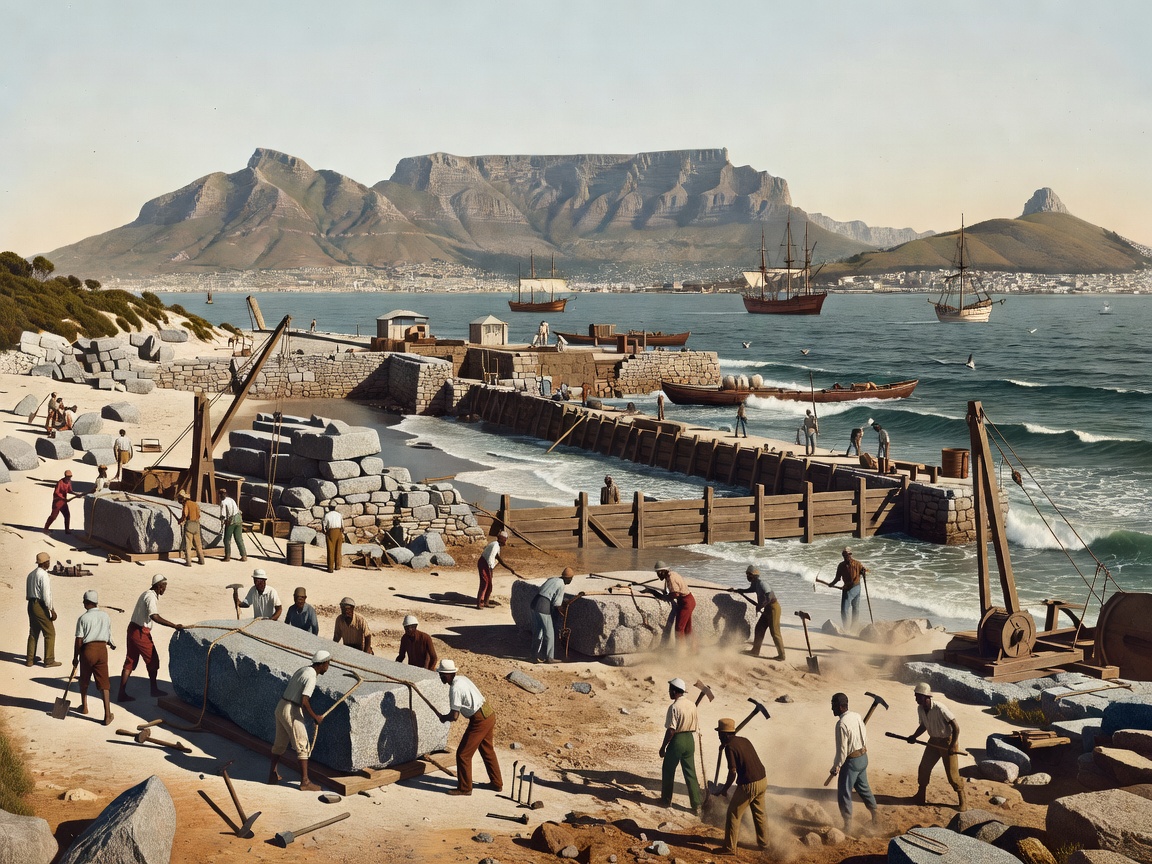
The Early Years: Open Anchorage and Shipwrecks
Before the vast concrete quays and towering gantry cranes defined the skyline, the area now known as the Port of Cape Town was merely a natural indentation along the coastline, referred to as Table Bay. In the 17th century, the Dutch East India Company (VOC) established a revictualling station here to service ships traversing the spice route between Europe and the East Indies. While geographically strategic, Table Bay was notorious for its exposure to fierce north-westerly winter gales.
During these early centuries, vessels anchored in the open bay and cargo was laboriously transferred via small lighters to the shore. The lack of a protective breakwater meant that winter storms routinely drove ships onto the beaches, resulting in catastrophic loss of life and cargo. The high risk of shipwrecks forced maritime authorities of the era to actively discourage winter docking, stunting the port's early commercial viability.
The Turning Point: The Prince Alfred Breakwater
The imperative to secure the bay grew critical by the mid-19th century. In 1860, Prince Alfred tipped the first load of stones for the construction of a protective breakwater, fundamentally altering the trajectory of Cape Town's maritime capabilities. This engineering milestone led to the development of the Alfred Basin, the port's first safe harbor, which allowed vessels to dock securely regardless of the season.
As the discovery of diamonds and gold inland spurred massive economic expansion, the Alfred Basin quickly proved inadequate for the volume of maritime traffic. The subsequent decades saw continuous expansion, most notably the construction of the Victoria Basin. By the turn of the 20th century, the port possessed robust dry dock facilities, slipways, and extensive storage sheds, laying the groundwork for a modern industrialized port.
The Duncan Dock and Foreshore Reclamation
Between 1937 and 1945, the port underwent its most ambitious transformation to date. The construction of the massive Duncan Dock involved dredging vast quantities of sand from the seabed, which was then used to reclaim 194 hectares of land. This colossal engineering feat created the modern Cape Town Foreshore, effectively moving the city center closer to the harbor.
The Duncan Dock was designed to accommodate the largest mail ships and passenger liners of the era. It also heralded the construction of the Sturrock Dry Dock, completed near the end of World War II. At the time of its completion, the Sturrock Dry Dock was the largest in the southern hemisphere, capable of handling immense dreadnoughts and troopships, proving instrumental during the global conflict.
The Container Era: The Ben Schoeman Dock
The global shipping industry was revolutionized in the 1960s and 1970s by the advent of containerization. Standardized steel boxes replaced break-bulk cargo handling, necessitating entirely new port infrastructure. To meet this demand, the Port of Cape Town expanded outward into the bay once again, constructing the Ben Schoeman Dock in the late 1970s.
Specifically engineered for container handling, the Ben Schoeman Dock required deep-water berths, massive reinforced quays capable of supporting Ship-to-Shore (STS) cranes, and expansive back-of-port terminal spaces for stacking. This development cemented Cape Town’s role as the primary export gateway for the Western Cape’s booming agricultural sector, particularly deciduous fruit and wine.
Modern Challenges and Future Masterplans
Today, the Port of Cape Town operates as a complex, multi-purpose facility managed by the Transnet National Ports Authority (TNPA). While its historical footprint is a testament to engineering ambition, the modern port faces significant constraints. The port is entirely landlocked by the city center, limiting physical expansion. Furthermore, the increasing size of ultra-large container vessels (ULCVs) necessitates continuous dredging and berth deepening.
Current development plans focus heavily on efficiency and modernization rather than mere physical expansion. Investments are being directed toward automated tracking systems, hybrid rubber-tyred gantries (RTGs), and mitigating the operational downtime caused by the infamous "Cape Doctor"—the powerful south-easterly summer winds that can force crane operations to halt.
Understanding the history of the Port of Cape Town is essential to grasping its current operational realities. The facility is a product of continuous adaptation, evolving from a dangerous colonial outpost into a highly specialized anchor of the South African economy.